Words: Mike Ryan
Photos: Courtesy of Seller
If you thought the Territory was Ford’s first Australian built all-wheel drive vehicle, think again. More than 30 years before that SUV, Ford released a rugged off-roader to the public, based on the venerable XY Falcon ute.
In the late 1960s, the recreational four-wheel drive market was growing. Like-minded individuals were coming together to undertake off-road treks and modify their vehicles. The Toyota LandCruiser Club of Australia was founded in 1969, with a Nissan Patrol Club following in 1976.
While the market for off-road vehicles was evident, it didn’t accelerate in the 1970s like the panel van scene did. Australia’s three main automotive manufacturers all jumped to introduce vehicles to feed the panel van fad, but didn’t do the same for four-wheel drive enthusiasts - with one exception.
Military Matters
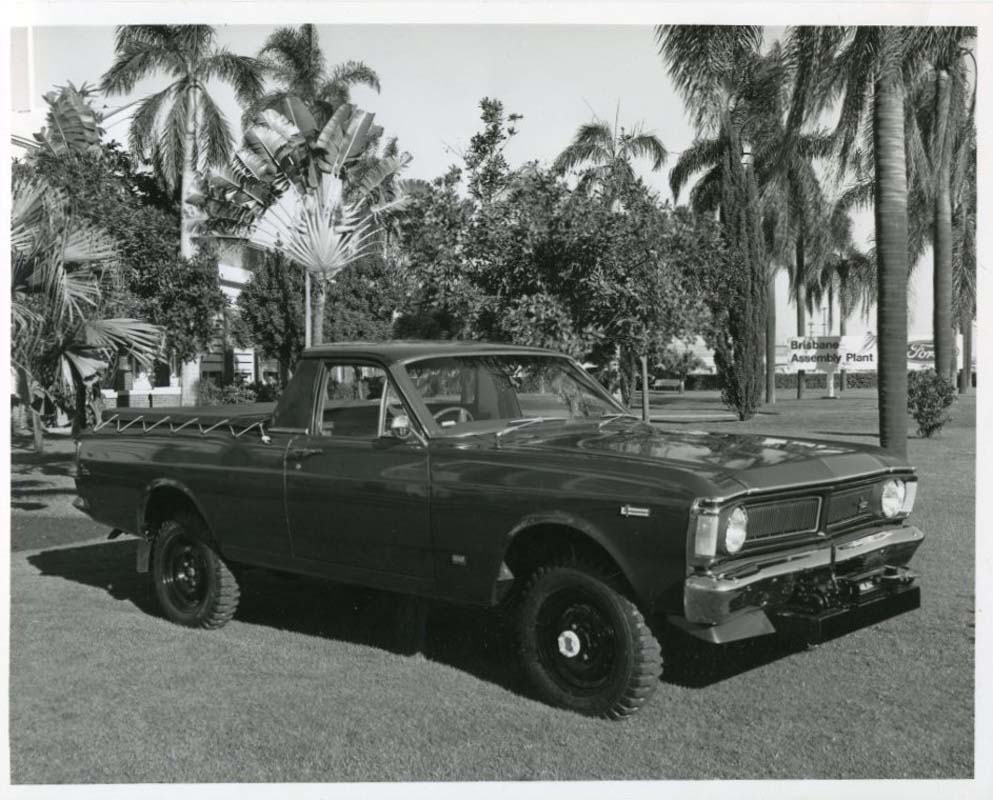
Ford’s XY Falcon-based 4WD ute was released in 1972, but its origins go back years earlier. In the late 1960s, the Australian Army put out a tender to the local automotive industry to develop a light truck - to replace their four-cylinder Land Rovers - that combined four-wheel drive capability with six-cylinder performance.
Ford were uniquely placed to respond to the tender, as their Brisbane factory at Eagle Farm was working with Willys Motors, who were assembling 4WD Jeeps locally. Built using CKD kits from the US and a selection of Australian-made parts, these Jeeps featured six-cylinder engines and transmission components supplied by Ford.
Ford thought they could meet the Army's needs by combining the 4WD-specific parts from the Jeep with their own bodies and running gear. A Falcon ute would be the subject for this Frankenstein creation, but the hurdles in making a vehicle designed for the road into something that could survive a war zone soon became apparent.
More Steel, More Strength
The key difference between the 2WD Falcon ute and the 4WD Land Rover was that the former was a monocoque and the latter used body-on-frame construction that was much more suitable for off-road use. Rather than develop an all-new body, Ford reasoned that bracing the Falcon’s monocoque in key areas would suffice.
Steel reinforcement was fitted throughout to handle the demands of off-road use, as well as the extra weight of front-end changes that included not just the driven front axle, but leaf-spring suspension, instead of coil springs and shocks.
Even with all this extra steel, early testing showed cracks in the body, requiring further reinforcement. This included a sturdy brace connecting the firewall to the strut towers.
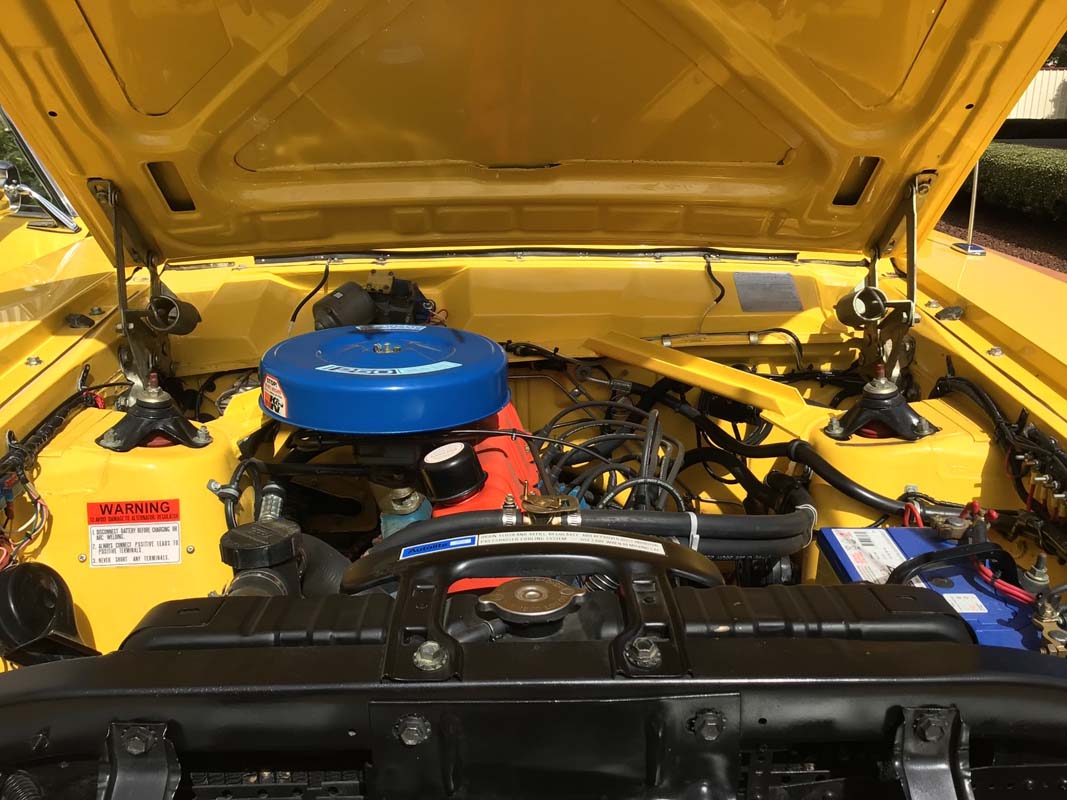
To fit their 250ci (4.1 litre) straight six around these reinforcements, plus the front diff, Ford tilted the engine in the style of Chrysler’s Slant Six. This also ensured the sump didn’t hang below the axle line, limiting the potential for damage. No consideration was given to developing the Falcon 4WD to take Ford’s 302ci or 351ci V8 – the Army wanted performance, but not that much performance!
For the transmission, Ford's standard three-speed manual would be combined with a Spicer centre diff, using a floor shifter, with the stick for the two-speed transfer case alongside. Front hubs were of the manual-locking type, supplied by Brisbane-based Shute Upton Engineering, who also provided important guidance on the vehicle’s development.
Army Reject, Civilian Hero
For all the effort and money Ford spent developing the Falcon 4WD, it was turned down by the Army, who determined that a Land Rover with a 2.6-litre six (that had been released in 1967) would be more suitable.
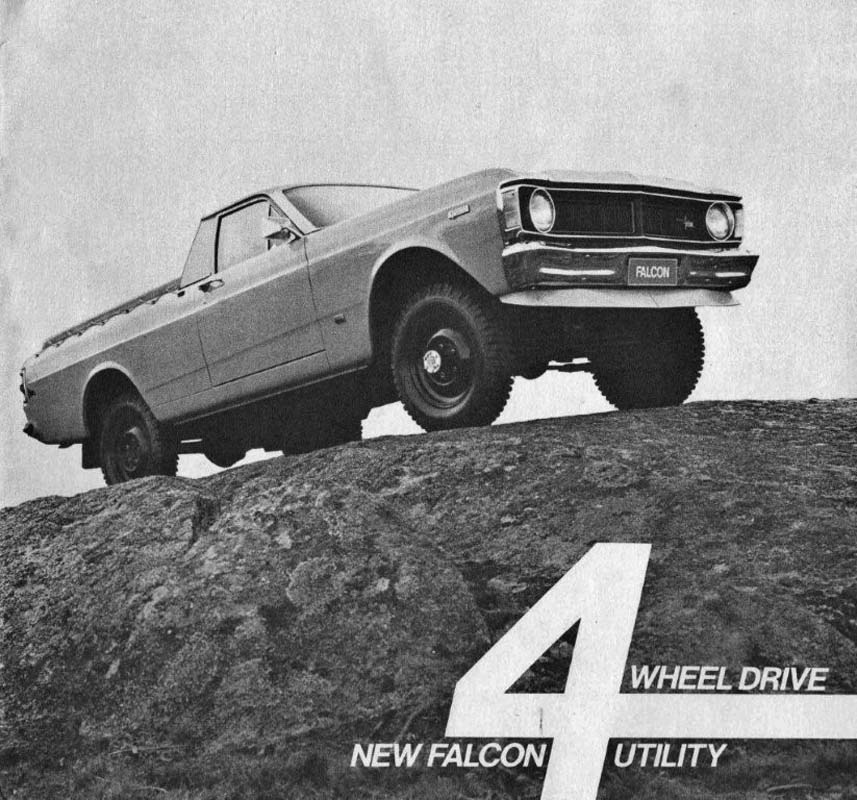
Unwilling to see their work go to waste, Ford decided to offer the four-wheel drive ute to the civilian market. As mentioned, recreational four-wheel driving was growing, so there was that source of customers, with farmers thought to be a good target for the vehicle, too.
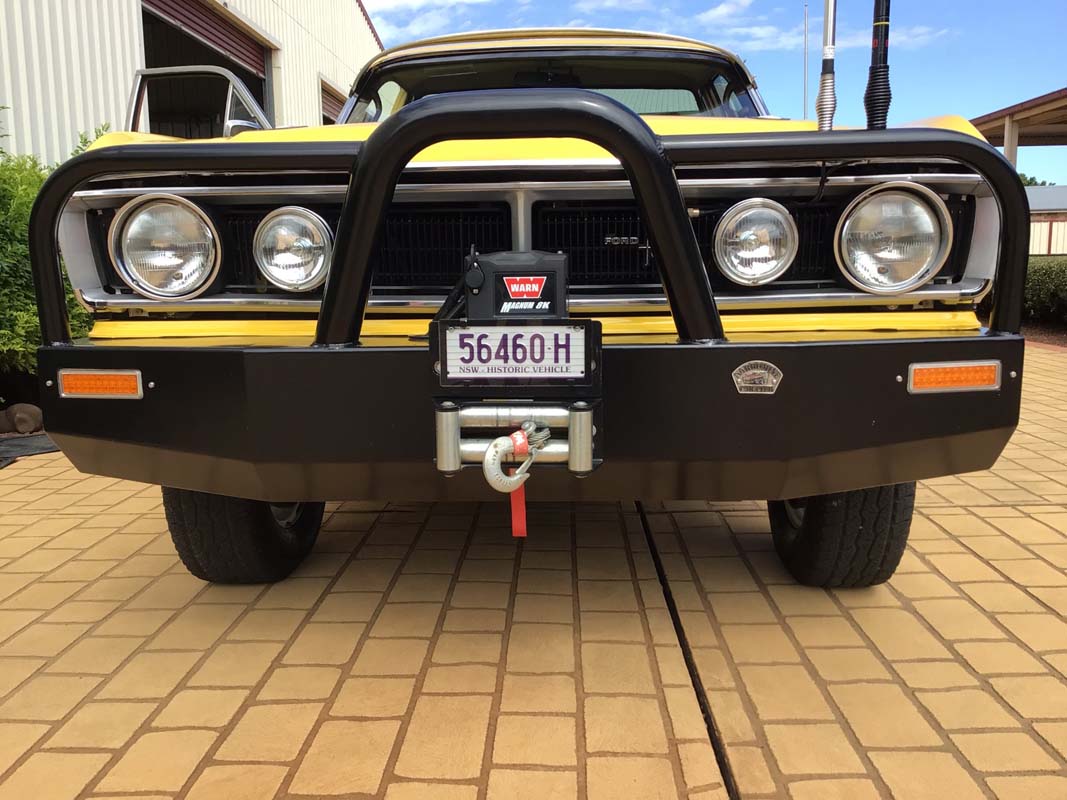
In bringing the Falcon 4WD to the civilian market, very little changed from the Army-spec vehicle. One quirky addition was the same front spoiler used on the Falcon GT-HO, in this application to mask the front-end running gear. Options included a high-top canvas canopy, heavy-duty towbar, and an 8,000lb Ramsey PTO winch, driven off the centre diff.
XY in an XA World
Ford had intended to release the Falcon 4WD in late 1971, but delays in the ordering and receipt of the Dana front axles that were essential to the project dragged on for over a year. As such, when the XY-based vehicle officially debuted in November, 1972, XA Falcons had been on the market for eight months.
To ensure parts and appropriate dealer servicing was available, sales were limited to New South Wales and Queensland. While never offered outside these two states originally, the Falcon 4WD utes can now be found in every state and territory in Australia, as well as New Zealand.
In total, only 432 examples of the Falcon 4WD were built. Ford sold every single one, but the program wasn’t economical, so these vehicles would remain orphans within Ford's range until the AWD Territory was released in 2004.
Today, the survival rate for Falcon 4WDs is good, with a nationwide owners’ group and enthusiast conversions of XY Falcon sedans and station wagons using the same components. Only the utes are the real deal, though, and the example featured is one of the best, as well as one of the most travelled.
Allan’s Bright Spot
Allan Lane is mostly a Ford man. We say ‘mostly’ because he rates EH Holdens for their ability to negotiate dirt roads in the far west of NSW where he lives. He’s had a few Toyotas as work vehicles over the years, too.
Allan’s first car was a ’39 Mercury V8, followed by a ’39 Ford DeLuxe. Falcons, Customlines and Mainlines came after that. At the enthusiast level, an XT Falcon ute was the first canvas for Allan’s expression that was explored further with an XY ute he upgraded with a V8. A first-gen Mustang followed, with a sixth-generation example purchased more recently.
Although Allan had admired the Falcon 4WDs since they came out, having a business and mortgage to deal with meant owning one was a dream. So, when this one came up in 2006, he said it was like winning the lotto.
As Allan recalls: “A friend of mine was up the coast fishing and got talking to a bloke. He said something about me wanting a Falcon four-wheel drive, and this bloke said, ‘I’ve got one for sale’. I couldn’t believe that!”
The seller was put in touch with Allan, who along with his wife Lyn, travelled to Rylstone in central NSW to inspect the vehicle.
“It was original, it was going. The only thing was its dreadful colour – ‘Shadow Grey’. My wife said, ‘If you do it up, I won’t get in it if you leave it that colour!’,” Allan laughed.
Colour aside, the vehicle looked good, so a deal was done. The Falcon’s service book revealed it had been sold new in March, 1973, to the owners of Morambie Station near Broken Hill. It next appeared in the town’s Mazda dealership, where the third owner acquired it in 1998. Allan is the fourth owner.
“His idea was to use it to go around Australia with his wife,” Allan said of the third owner. “He’d tried to recondition the vehicle himself but then decided to go around Australia on a three-wheel motorbike instead.”
Good Bones, New Glow
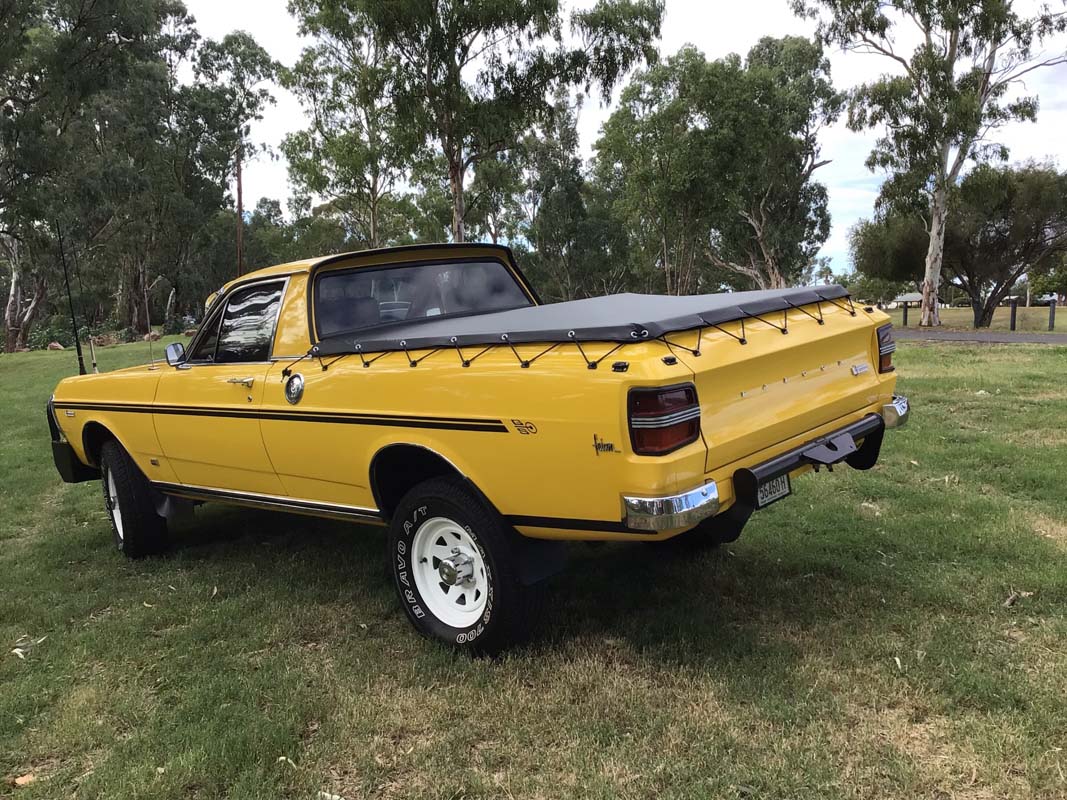
Being located in the far west of NSW since new, the Falcon had survived well, with rust only in the footwells. Farm use had seen the ute’s tub take a pounding, though, with the damage extending to the bracing underneath, but overall, the body was good. Nevertheless, Allan acquired a second Falcon 4WD as a donor and also dipped into his stock of parts from previous Falcon projects that included a pair of NOS front guards.
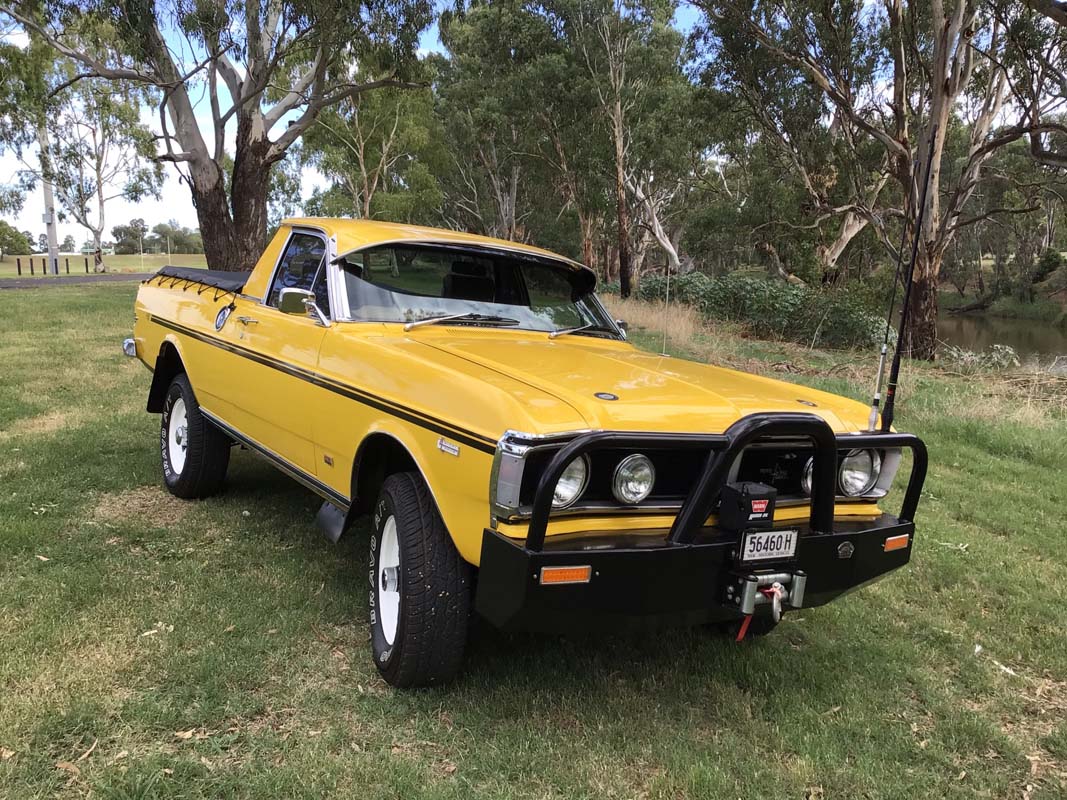
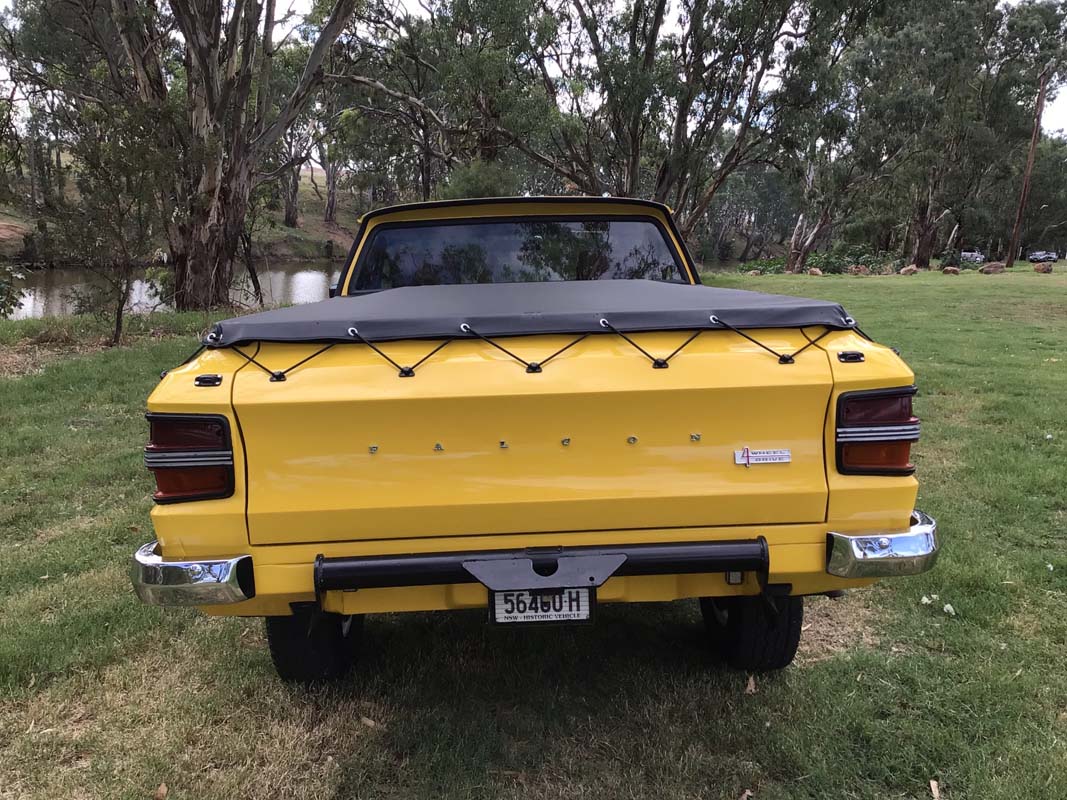
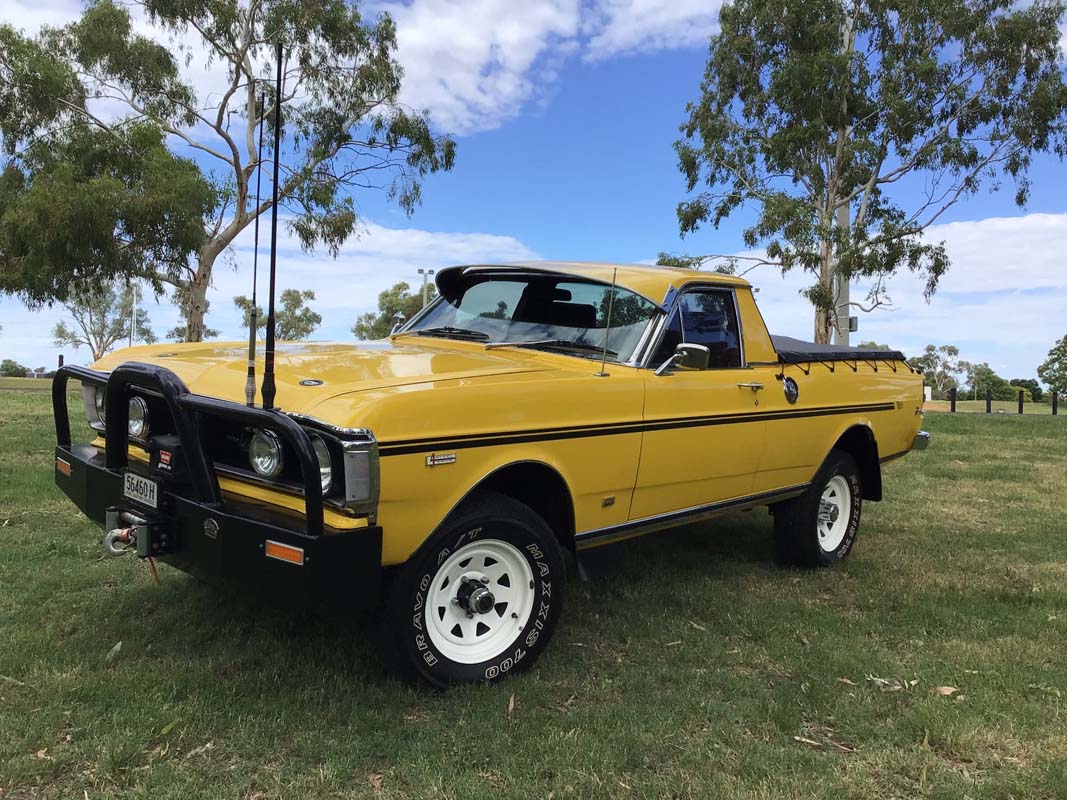
After stripping the body back to bare metal, Allan fabricated an all-new steel tub floor and added bracing into the B-pillar. New door skins were fitted, along with a second fuel tank (hence the filler caps on both sides) to increase capacity to 112 litres. After priming and reassembly, the ute was sent to Dubbo for painting. As instructed by Lyn, ‘Shadow Grey’ was out and ‘Yellow Glow,’ a popular Falcon GT colour, was in.
“I’ve always liked Yellow Glow,” Allan explained. “It’s a lovely colour and certainly attracts people’s attention.”
GS striping was a personal touch on Allan’s part, but suits the vehicle well, as does the external sunvisor. Sunraysia wheels and Maxxis tyres were also added by Allan.
Original Power, Aftermaket Extras
The ute’s original 250ci engine was stripped and rebuilt for the restoration, as was the transmission, transfer case and diffs. Some parts were hard to get, but a supplier in Queensland proved to be a good source for the rare stuff, while being a member of the Falcon 4WD owners’ group helped, too.
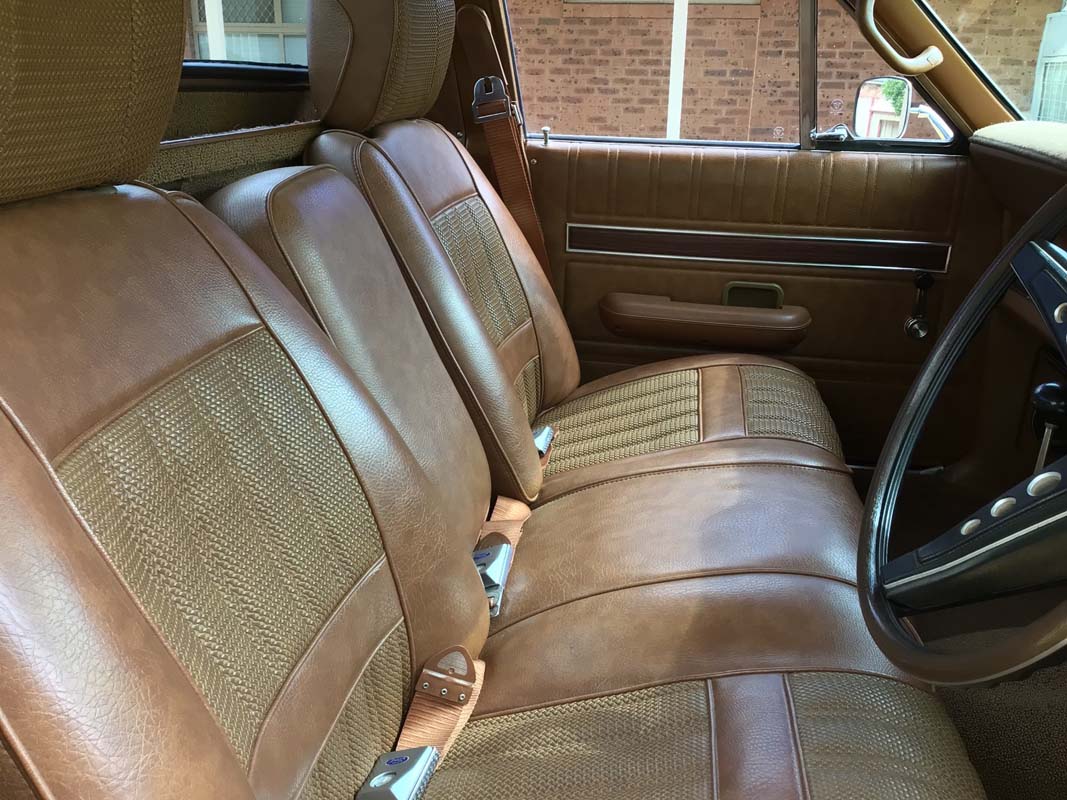
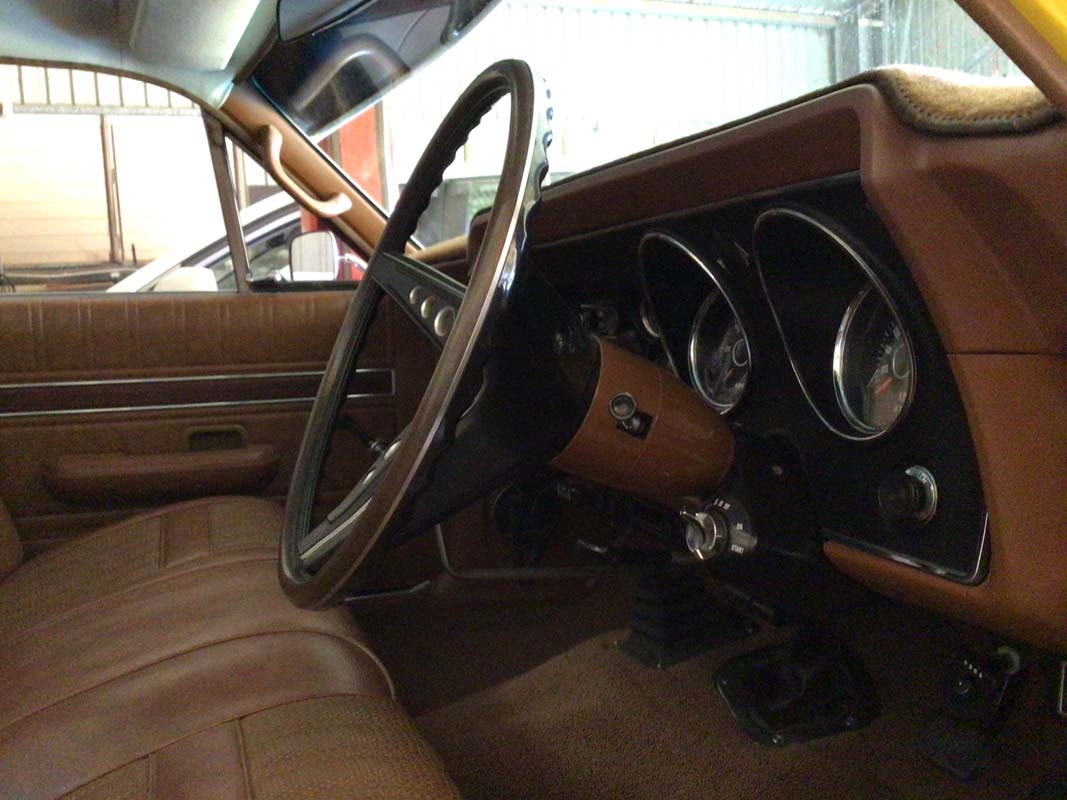
All new glass was fitted, while the interior received new door trims and new upholstery for the bench seat. A full-gauge GS dash came from Allan’s parts stock.
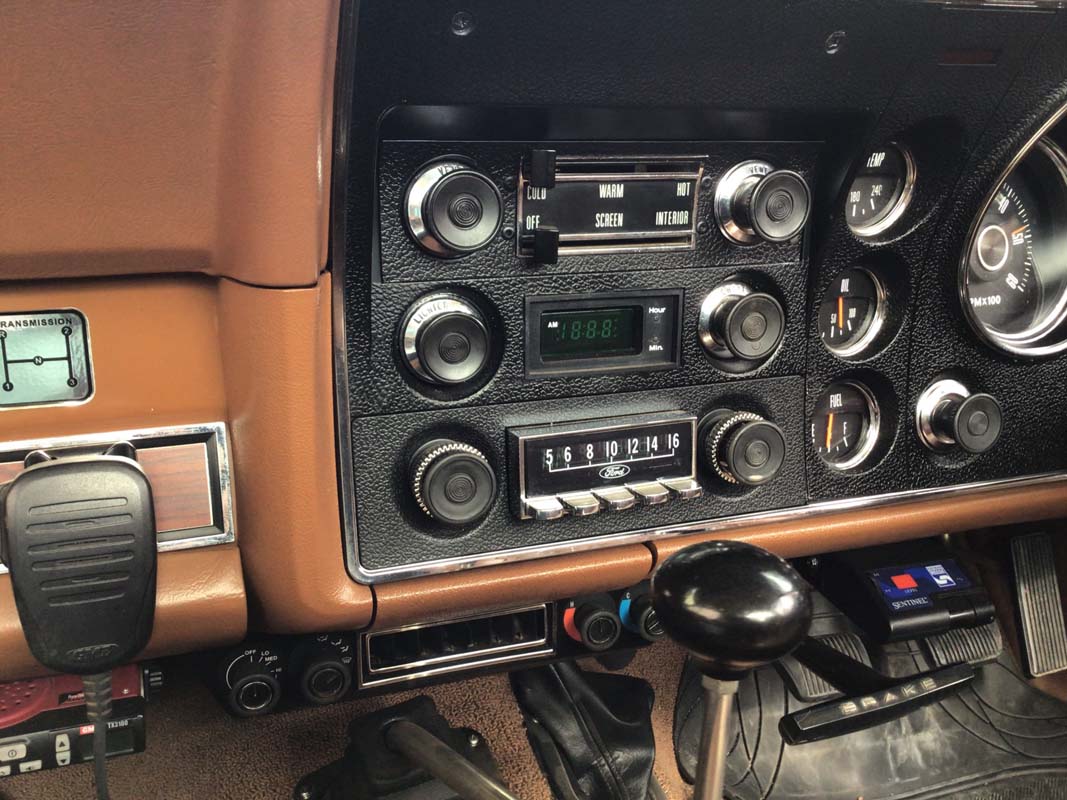
Incorporating a Vintage Air air conditioning kit while maintaining legroom required the glovebox to be shortened, so a lockable storage box was fabricated to sit behind the driver. Allan also fitted a Hayman Reece trailer brake kit, along with a GME UHF radio. The factory stereo was upgraded to four speakers, split between the kick panels and B-pillar.
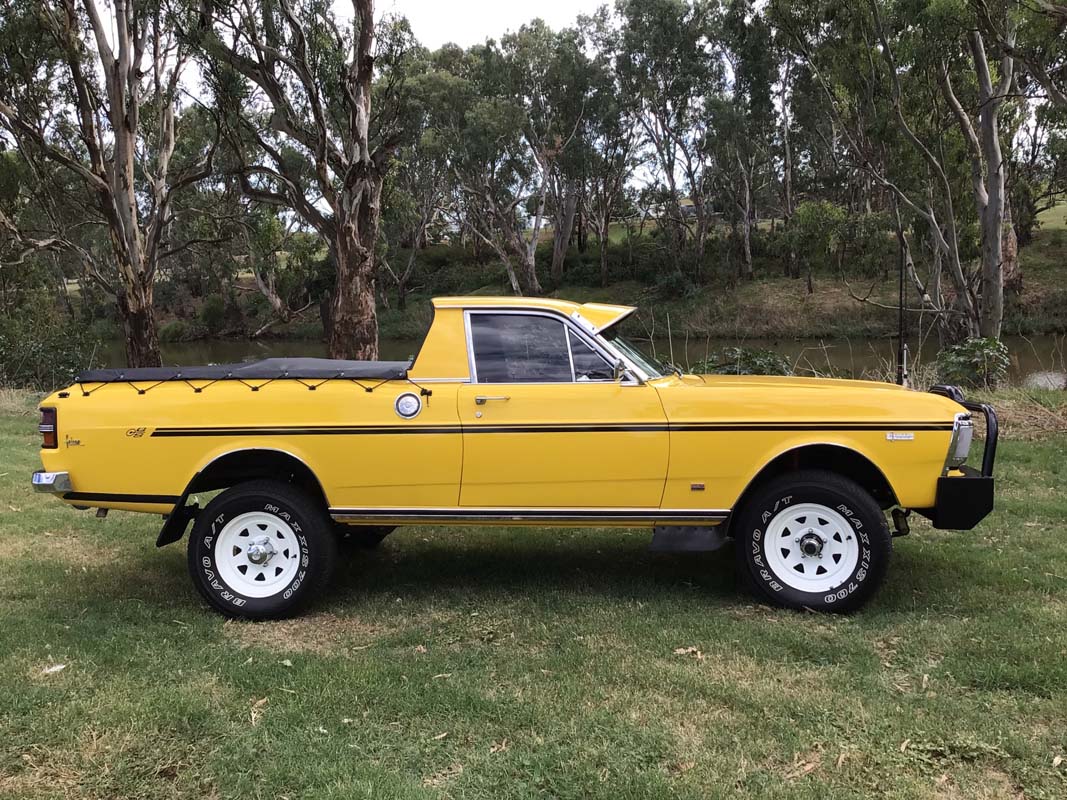
The distinctive front bumper and bullbar was custom made by a specialist in Narromine, NSW, then fitted with a Warn 8,000lb electric winch. The same specialist also fabricated a tow bar with an integral step for easier entry to the tub. This will be included in the sale, along with a XY-ute fibreglass canopy from Canopy Industries.
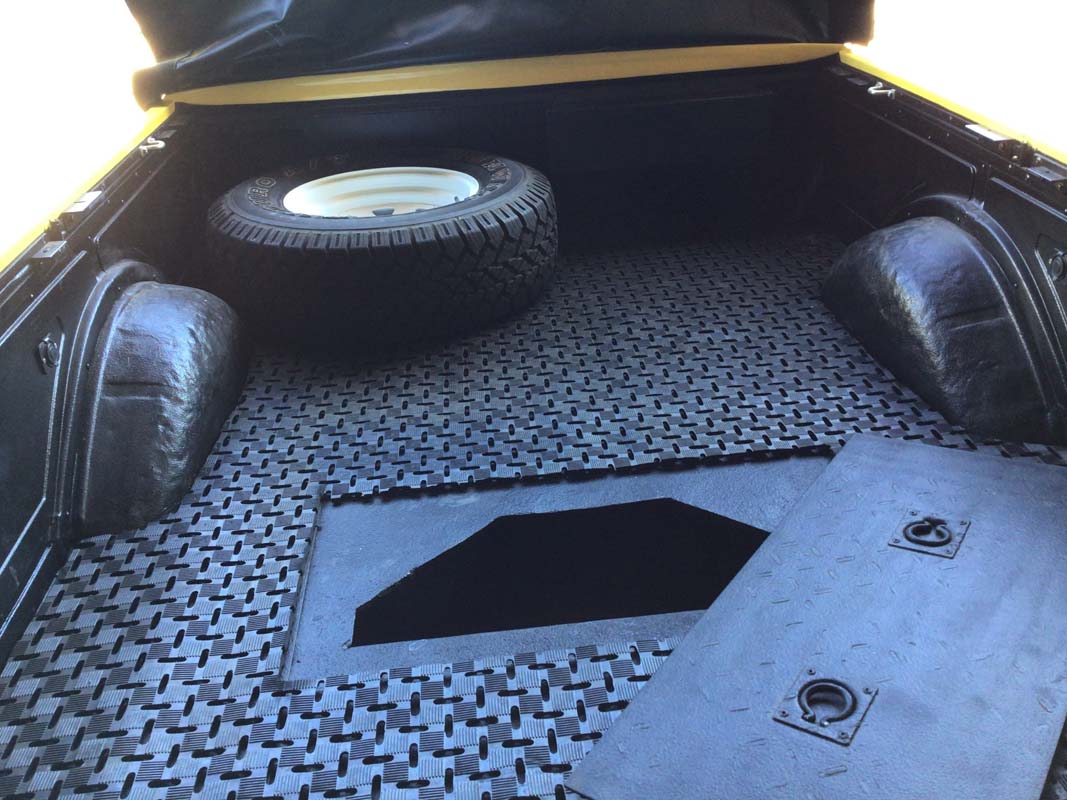
Those wider Sunraysia wheels and tyres meant the factory spare wheel storage slot was unusable, so that’s been repurposed to hold essential tools and spares for travelling in remote areas. The spare wheel is now fastened to the ute tub using a bespoke bracket, with a couple of 12V outlets installed in the tub, too.
Ultimate Test
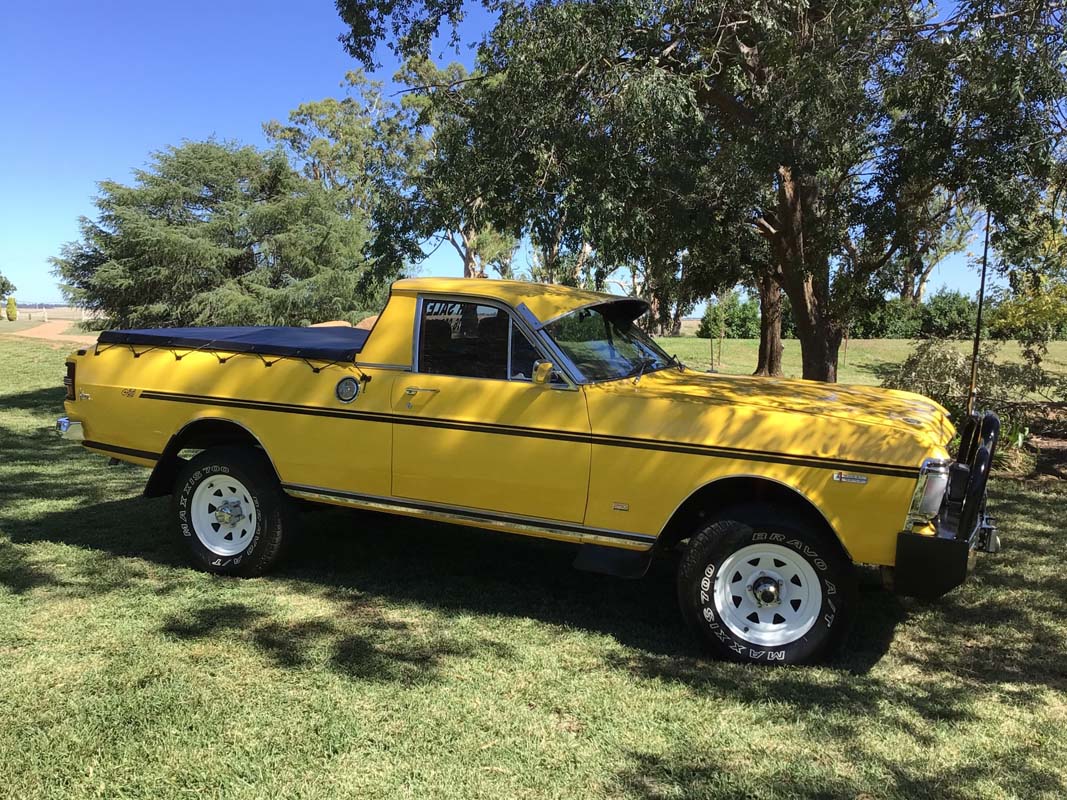
Completed in 2010, this ute’s thorough restoration only took four years, thanks in part to its good condition as purchased. Allan did all the wiring himself (he’s an electrician by trade), but turned to a trusted group of professional tradespeople for the mechanical, paint and upholstery work.
Shortly after the rebuild was done, Allan took his fresh ute on a real road test – a two-week trip across the Simpson Desert and back! Taking in Broken Hill, Oodnadatta, the old Ghan railway, Moree and Birdsville, the 4WD passed this test with flying colours.
“The old Falcon amazed everyone,” Allan recalled. “Modern 4x4s had to go back about half a kilometre to get a run up (on the dunes), but we just started at the base and climbed over them. This thing will climb out of a mine shaft!”
It’s since been used on extensive tours throughout NSW and Southern Queensland, also hauling a custom camper trailer on various adventures. It’s been a trophy winner and head turner at car shows, too.
Amazing – with a Caveat
Allan says the time taken with the restoration of this Falcon 4WD has paid off, making it enjoyable off-road and on long drives, where it really excels.
That leaf spring front end means the turning circle is substantial, at more than 11 metres (55 feet), and slow speed manoeuvring is tough without power steering, but once up and running, the ute performs and handles well. Comfortable at 80km/h, it can hit 130km/h.
Allan says the real beauty of this vehicle is not in its appearance, but the places it allows you to go. Off the beaten track, it’s virtually unstoppable - “you can hop in it and go wherever you want.”
For the enthusiast of classic Fords with an adventurous spirit, it’s hard to think of a better vehicle than this.
FOR SALE
A rare vehicle, this Falcon 4WD has been fully restored, with almost 38,000km covered since, and remains in very good condition.
It retains its original six-cylinder engine (modified to take unleaded), three-speed transmission and factory front/rear diffs.
The cabin has been fitted with a GS dash, UHF radio and air conditioning (recently refurbished), but maintains a factory look, with some modern additions for comfort.
Reduced in price to $95,000 ono. Click HERE for more details.